
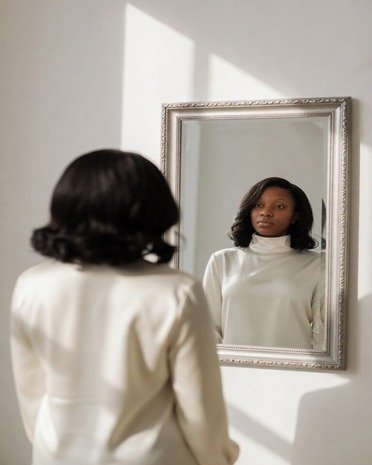
Who are you when nobody is watching?
Not the version of you that shows up at work, around friends, at church, or on social media. I mean the version that exists in the quiet moments—the one nobody will ever compliment, criticize, or applaud you for.
It’s a simple question, but it might be surprisingly difficult to answer.
Growing up, my dad had a saying he repeated often: “You can deceive everyone, but you can’t deceive yourself.”
At the time, I thought it was just another one of those pieces of advice that parents often use when they want to scold you.
But the older I’ve become, the more I’ve realized there was something deeper in it. His words weren’t really about deception. They were about self-awareness. They were a reminder that beneath every role we play and every image we project, there is a version of ourselves that knows the truth.
The question is whether we take the time to listen to that version.
The Gap Between Who We Are and Who We Appear to Be
Most of us spend a lot of time thinking about how we’re perceived.
That’s not necessarily a bad thing. We all want to be respected, trusted, and understood. The challenge is that it’s easy to become more invested in managing our image than understanding our reality.
A conversation I had recently brought this home for me.
In a group discussion, someone shared that they had been struggling with a personal issue for years but had never spoken openly about it. When asked why, their answer was simple: they didn’t want people to see them differently.
What struck me wasn’t the struggle itself. It was how familiar the reasoning sounded.
Many of us carry an unspoken pressure to appear capable, strong, or in control. Over time, we become attached to the version of ourselves that others know. We protect it carefully because we’ve worked hard to build it.
But sometimes, in protecting that image, we lose touch with what’s happening underneath it.
Character Is Built in Small Moments
When people talk about character, they often imagine big tests of integrity or life-changing decisions.
In reality, character is usually built in much quieter ways.
It’s built on the promises you make to yourself when nobody is watching. It’s built in how you treat people. It’s built in the decisions you make when no one would know the difference either way.
These moments rarely feel important while they’re happening. They don’t earn recognition. Yet they reveal something important about who we are.
Public achievements may shape our reputation, but private choices shape our character.
And unlike reputation, character follows us everywhere.
The Conversation We Have With Ourselves
Of all the things that reveal who we are, I think our inner voice may be one of the most telling.
Consider what happens when you fail at something privately.
Not when everyone sees it. Not when you’re forced to explain it.
Just when it’s you, alone, sitting with the disappointment.
What does that voice sound like?
For some people, it’s relentlessly critical. For others, it’s understanding and constructive. Most of us move somewhere between those extremes.
The reason this matters is that the relationship we have with ourselves influences nearly everything else. It affects our confidence, our resilience, the risks we’re willing to take, and how quickly we recover from setbacks.
Yet it’s often the relationship we pay the least attention to.
An Invitation to Pay Attention
I don’t think knowing yourself is a destination you arrive at one day.
It’s an ongoing practice.
It’s choosing to notice your reactions, your habits, your motives, and the stories you tell yourself. It’s being willing to look honestly at who you are without immediately judging what you find.
That kind of honesty can be uncomfortable, but it’s also freeing.
The less energy we spend performing, the more energy we have for living. The less attached we become to maintaining an image, the easier it becomes to act from our values instead of our fears.
And perhaps that’s what my dad meant all those years ago.
You may be able to convince other people of many things, but eventually you have to live with yourself.
One Question Worth Sitting With
So I’ll leave you with the question that has been on my mind lately:
Who are you when nobody is watching?
Not the best version of yourself on your best day.
Not the version you present to the world.
I mean the everyday you. The one who makes choices in private, talks to themselves when things go wrong, and keeps showing up when there is no audience.
Do you know that person?
And if the answer isn’t clear yet, maybe that’s not a problem to solve.
Maybe it’s simply an invitation to pay closer attention.
One last question before you go:
What’s something you’ve learned about yourself in a moment when nobody else was watching?
Share your thoughts in the comments. Let’s have an honest conversation.
With love,
Cheta Otiji
You might also enjoy:
6 thoughts on “Who Are You When Nobody Is Watching?”
I’m stronger than I thought when no one is encouraging me.”
I need rest more than I need to keep pushing.”
My values become clearer when nobody is watching.
Hum!!!
In moments when nobody was watching, I learned that my character is defined by the choices I make in private. Those quiet moments revealed both my weaknesses and my strength, and they taught me the importance of integrity, self-discipline, and dependence on God.”
Yes, our true character are in the choices we make daily. Thank you ma’am.
Who am I when no one is watching? Hmmm… an in-depth question.
I’ll keep paying closer attention to be more self aware. Tnanks aunty.
Thank Seun.
My darling, do you know that you are a blessing to most of us?….
Well, let me explain…..
I’ve done this over and over again.
Who do people see me to be and who am I, really?
Yes, no one wants to be perceived wrongly or seen to be doing what is wrong; that is understandable.
I did something im not proud of in my 42nd year of life. It made me feel less of myself. I said to myself, ” im not special, afterall”. O use to be judgemental, until after that event. I began to see myself as a normal person, and being ordinary as every other woman out there. My self esteem was affected and I still try to cover that part of me from everyone.
I struggle to say to myself that that is not me. I refuse to accept that as my identity.
Even when no one is watching, we should maintain our dignity.
Now the constant check on who we really are and who we are being perceived to be is very important. So that the situation of things happening around us, don’t make us to be persons of questionable character.
I will leave us by charging us to always do that which is good.
Choose “good”, always.
Awwwwn, thank you so much for sharing this @Doris.Yes,we all have our individual struggles, and that is what makes us human.
I am glad that you check in with yourself from time to time. We all need to truly know who we are and not the version we present to others.
Thank you ma’am for always being here.